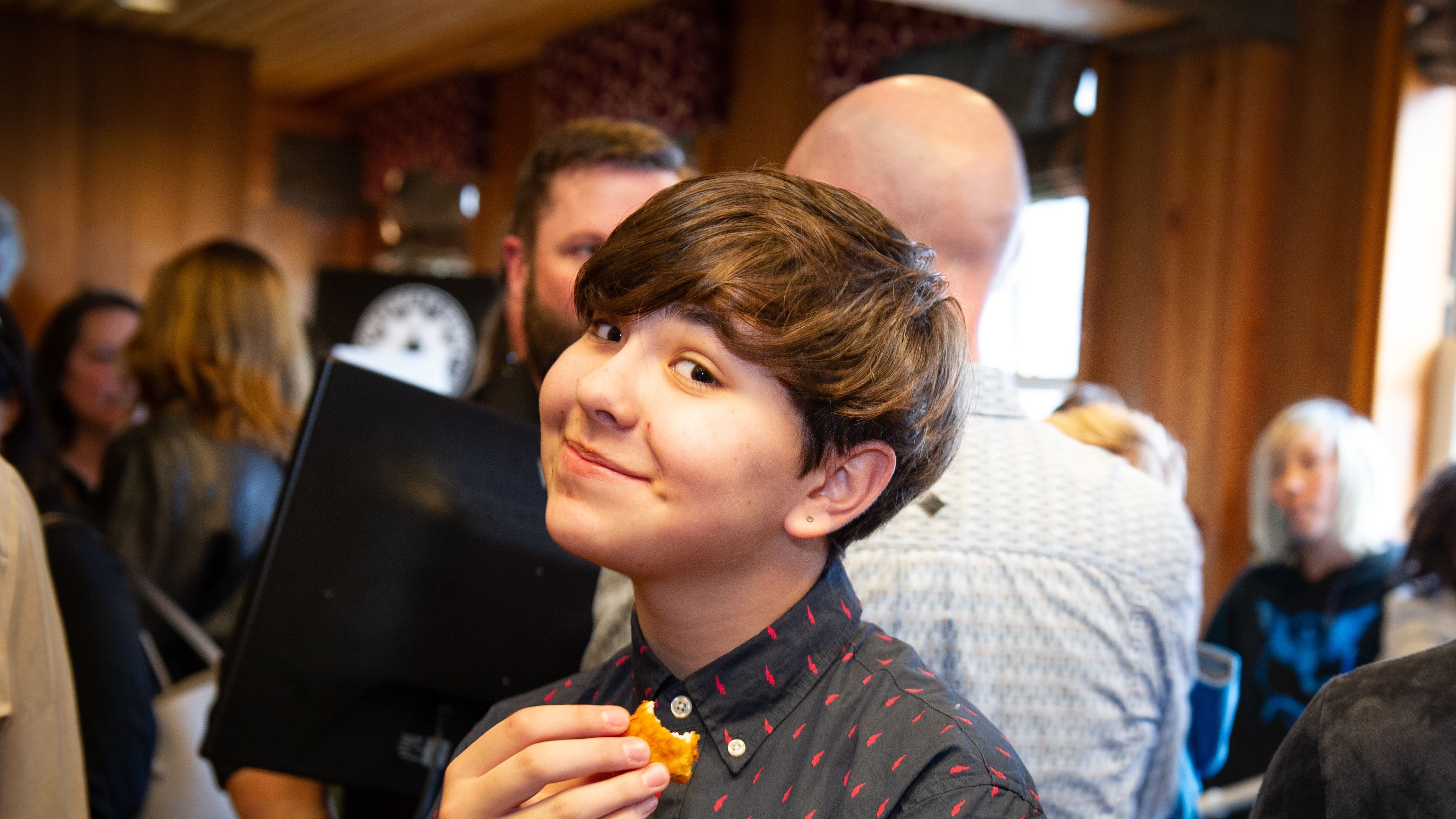

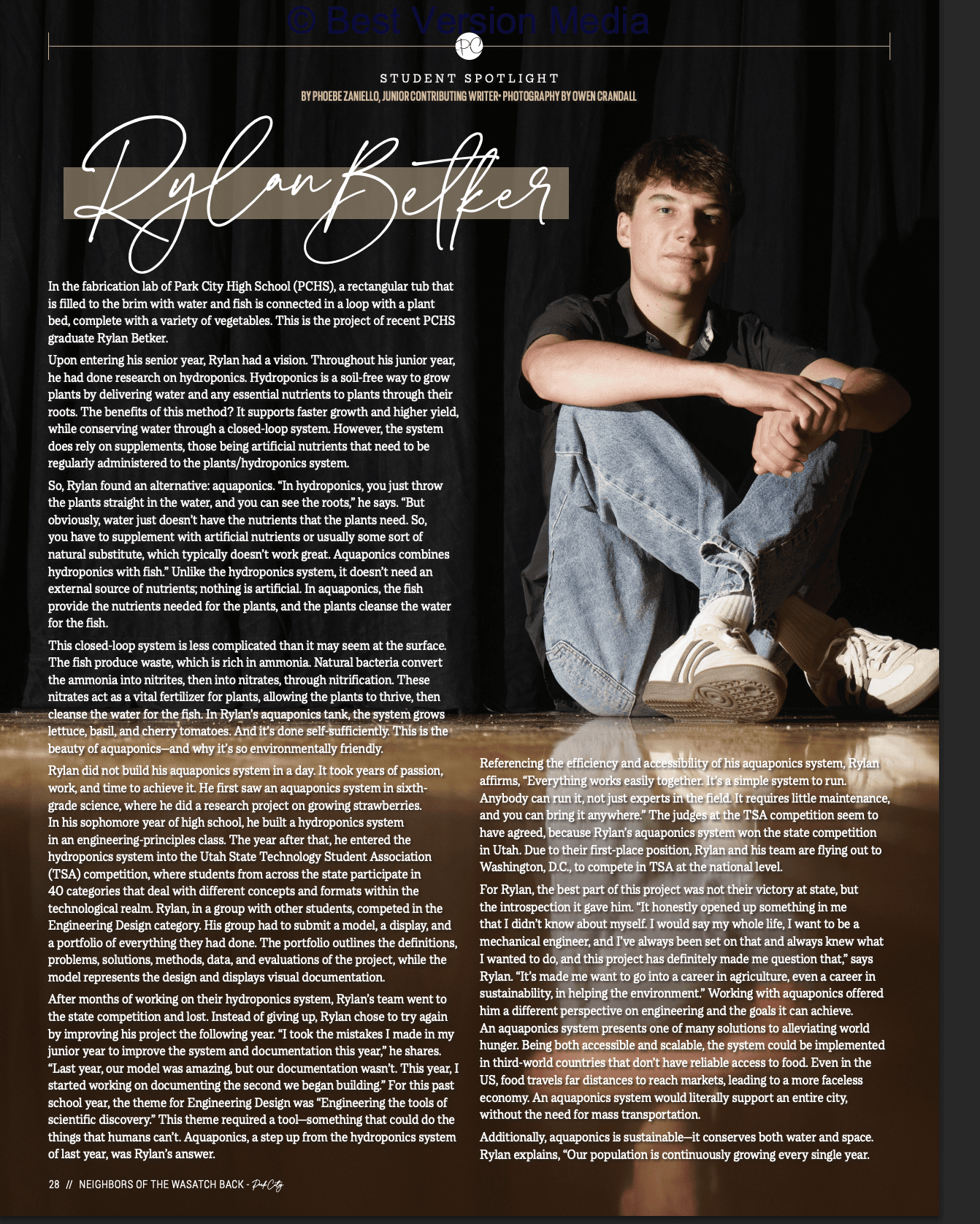
In the fabrication lab of Park City High School (PCHS), a rectangular tub that is filled to the brim with water and fish is connected in a loop with a plant bed, complete with a variety of vegetables. This is the project of recent PCHS graduate Rylan Betker.
Upon entering his senior year, Rylan had a vision. Throughout his junior year, he had done research on hydroponics. Hydroponics is a soil-free way to grow plants by delivering water and any essential nutrients to plants through their roots. The benefits of this method? It supports faster growth and higher yield while conserving water through a closed-loop system. However, the system does rely on supplements, those being artificial nutrients that need to be regularly administered to the plants/hydroponics system.
So, Rylan found an alternative: aquaponics.
"In hydroponics, you just throw the plants straight in the water, and you can see the roots," he says. "But obviously, water just doesn't have the nutrients that the plants need. So, you have to supplement with artificial nutrients or usually some sort of natural substitute, which typically doesn't work great. Aquaponics combines hydroponics with fish."
Unlike the hydroponics system, it doesn't need an external source of nutrients; nothing is artificial. In aquaponics, the fish provide the nutrients needed for the plants, and the plants cleanse the water for the fish.
This closed-loop system is less complicated than it may seem at the surface. The fish produce waste, which is rich in ammonia. Natural bacteria convert the ammonia into nitrites, then into nitrates through nitrification. These nitrates act as a vital fertilizer for plants, allowing the plants to thrive while cleansing the water for the fish. In Rylan's aquaponics tank, the system grows lettuce, basil, and cherry tomatoes. It's done self-sufficiently. This is the beauty of aquaponics—and why it's so environmentally friendly.
Rylan did not build his aquaponics system in a day. It took years of passion, work, and time to achieve it. He first saw an aquaponics system in sixth-grade science, where he did a research project on growing strawberries.
In his sophomore year of high school, he built a hydroponics system in an engineering-principles class. The year after that, he entered the hydroponics system into the Utah State Technology Student Association (TSA) competition, where students from across the state participate in 40 categories that deal with different concepts and formats within the technological realm. Rylan, in a group with other students, competed in the Engineering Design category. His group had to submit a model, a display, and a portfolio of everything they had done. The portfolio outlined the definitions, problems, solutions, methods, data, and evaluations of the project, while the model represented the design and displayed visual documentation.
After months of working on their hydroponics system, Rylan's team went to the state competition and lost. Instead of giving up, Rylan chose to try again by improving his project the following year.
"I took the mistakes I made in my junior year to improve the system and documentation this year," he shares. "Last year, our model was amazing, but our documentation wasn't. This year, I started working on documenting the second we began building."
For this past school year, the theme for Engineering Design was "Engineering the tools of scientific discovery." This theme required a tool—something that could do the things that humans can't. Aquaponics, a step up from the hydroponics system of the previous year, was Rylan's answer.
Referencing the efficiency and accessibility of his aquaponics system, Rylan affirms, “Everything works easily together. It’s a simple system to run. Anybody can run it, not just experts in the field. It requires little maintenance, and you can bring it anywhere.” The judges at the TSA competition seemed to have agreed, because Rylan’s aquaponics system won the state competition in Utah. Due to their first-place position, Rylan and his team are flying out to Washington, D.C., to compete in TSA at the national level.
For Rylan, the best part of this project was not their victory at state, but the introspection it gave him.
“It honestly opened up something in me that I didn’t know about myself. I would say my whole life, I wanted to be a mechanical engineer, and I’ve always been set on that and always knew what I wanted to do, and this project has definitely made me question that,” says Rylan. “It’s made me want to go into a career in agriculture, even a career in sustainability, in helping the environment.” Working with aquaponics offered him a different perspective on engineering and the goals it can achieve.
An aquaponics system presents one of many solutions to alleviating world hunger. Being both accessible and scalable, the system could be implemented in third-world countries that don’t have reliable access to food. Even in the U.S., food travels far distances to reach markets, leading to a more faceless economy. An aquaponics system would literally support an entire city, without the need for mass transportation.
Additionally, aquaponics is sustainable—it conserves both water and space. Rylan explains, “Our population is continuously growing every single year. We’re at 8 billion people right now, and so every year, our demand for food becomes greater and greater. The Amazon is a great example. We’re destroying more and more land to raise cows and grow our crops. And so if you do aquaponics, you could take a warehouse, and you could vertically grow every single thing.”
However, engineering still remains central in Rylan’s future plans, even if he doesn’t know which type. Growing up, he would roam the internet to answer his curious questions, searching for all of the answers about how things work. Sometimes, he would just take things apart to teach himself their inner mechanics, although his greatest childhood fascination was with ski lifts, something that he couldn’t take apart. Like many Park City kids, he grew up skiing and slowly became obsessed with the machine that made it easier for him to ski.
“I somehow was able to teach myself exactly how ski lifts worked. I would literally look up at the mechanisms above me, and after many years of looking up, I figured it out. It made me realize how much I liked complicated systems,” Rylan says.
In school, he took classes that reinforced this passion. In CAD Mechanical Design 1 and 2, he learned how to work with AutoCAD and SolidWorks, which are both industry-standard Computer-Aided Design programs. Within the two programs, he learned 2D and 3D design, as well as how to draft, model, and simulate online. Knowing this software has helped Rylan in both his TSA projects and in other engineering goals.
Last year, he took a Park City Center for Advanced Professional Studies (PCCAPS) Engineering and Architecture course. The class is designed with project-based learning, with every student working with a client to meet an industry-related goal. For his first semester, Rylan worked with Park City Transit to design a new plan for the Kearns Campus. For his second semester, Rylan worked with RockWest Composites to design a carbon-fiber light fixture. The goal was to create a lightweight, stylish chandelier made out of carbon fiber. The original built fixture out of PVC, but after many redesigns, he created an effective and aesthetic light fixture.
“I’ve never seen myself as a creative person, but I thought the project sounded fun,” admits Rylan. “And then, several months in, I found myself just sitting in my room and designing light fixtures, even after the project had ended. I just love building something that’s complicated but appears so simple on the surface. It is truly fascinating.”
After the success of the project, Rylan was hired to do freelance work with RockWest Composites to continue building light fixtures. Now, he’s working on improving and scaling his light-fixture design as he finds buyers.
Next year, Rylan will attend Montana State University (MSU), likely to study engineering, perhaps with a minor in horticulture. His interest in MSU stems from the university’s location in the mountains and his brother’s attendance there. On studying engineering, he says, “I do want to stay in engineering; it’s just whether or not it will be mechanical. My engineering skills in coding, soldering, and crafting complicated electrical and computer components will prove helpful as a mechanical engineer, but I would love to focus on agriculture.” His experience in building an aquaponics system has fostered a passion for the environment, and now he wants to work to sustain it. He argues that “the human population will not survive if we keep doing what we’re doing, if we keep deregulating the environment and treating it so poorly.” Rylan believes that more solutions can be found within environmental engineering, specifically in the agricultural sector, like with his aquaponics system.
Reflecting on his high school experience, Rylan is most grateful for the resources he had available to him. PCHS’s fabrication lab, which is a newer addition to the building, is an open-concept makerspace complete with 3D printers, laser cutters, and CNC machines. The space has given Rylan the ability to build prototypes, test designs, and engage in hands-on learning.
“It allows me to work on a lot of cool technical stuff that I wouldn’t be able to work on in any class in high school ever,” says Rylan.
Rylan’s message to students is to emphasize the value of capitalizing on any and all opportunities.
“I have really taken advantage of the fact that Park City High School has so many fun and engaging classes,” he reflects. “And I took advantage of my PCCAPS client offering me a job. I’ve been given the opportunity to do lots of really cool research in high school. Don’t wait for these opportunities to come to you.”
For Rylan to even start his aquaponics project, he had to heavily persuade the TSA advisor. For a while, he couldn’t get funding, so he ultimately had to apply for a grant. Once he started, he worked three hours a day every day after school building the system. It was not luck that brought Rylan to his TSA state champion status, to his freelance job, or to his college aspirations; it was hard work, time, and effort.